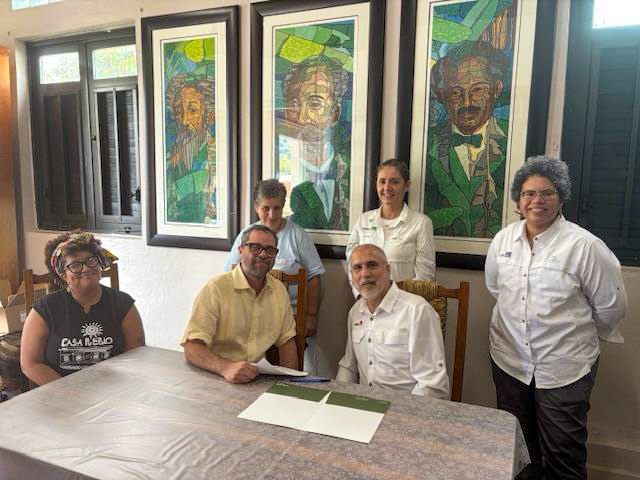
The alliance seeks to strengthen the protection, management, and ecological restoration of Bosque del Pueblo and Bosque de Pellejas, while reinforcing community-based conservation and jointly addressing the ecological and social challenges facing Puerto Rico’s islands.
With the goal of strengthening community conservation and responding collaboratively to the ecological and social challenges facing Puerto Rico and the planet, Casa Pueblo and Para la Naturaleza formalized a strategic alliance that establishes a framework for collaboration between both organizations and recognizes Casa Pueblo’s experience as a replicable community model.
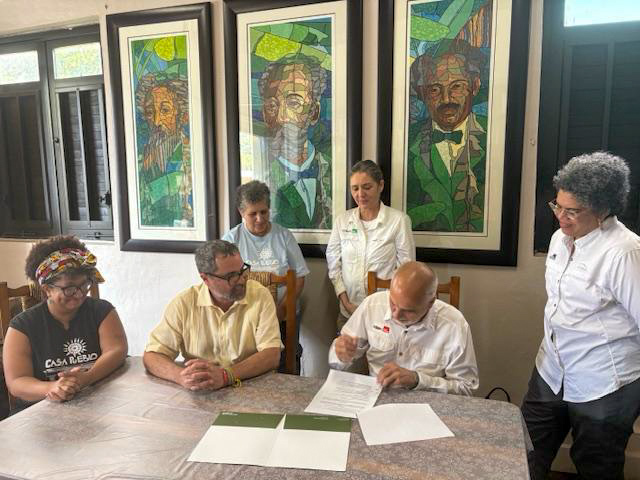
In the image, Arturo Massol Deyá, executive director of Casa Pueblo, and Fernando Lloveras San Miguel, president of Para la Naturaleza, sign the agreement through which both organizations establish this strategic collaboration.
The agreement was signed on Tuesday, January 20, 2026, at Casa Pueblo in Adjuntas by Fernando Lloveras San Miguel, president of Para la Naturaleza, and Arturo Massol Deyá, executive director of Casa Pueblo. The alliance establishes a collaborative framework to support initiatives for protection, management, and ecological restoration in Bosque del Pueblo and Bosque de Pellejas, with the aim of enhancing their ecological and community value.
Considered actions include the exchange of management plans, biodiversity inventories, and available scientific data, as well as the creation of joint teams to conduct technical site visits to both forests. These assessments will also document the biodiversity recovered as a direct result of decades of community-based conservation efforts in Bosque del Pueblo.
As part of this process, the use of aerial monitoring technology is envisioned to support forest monitoring efforts and evaluate ecological connectivity alternatives between the two forests—for example, through the establishment of trails or connecting pathways to maximize their ecological and community value.
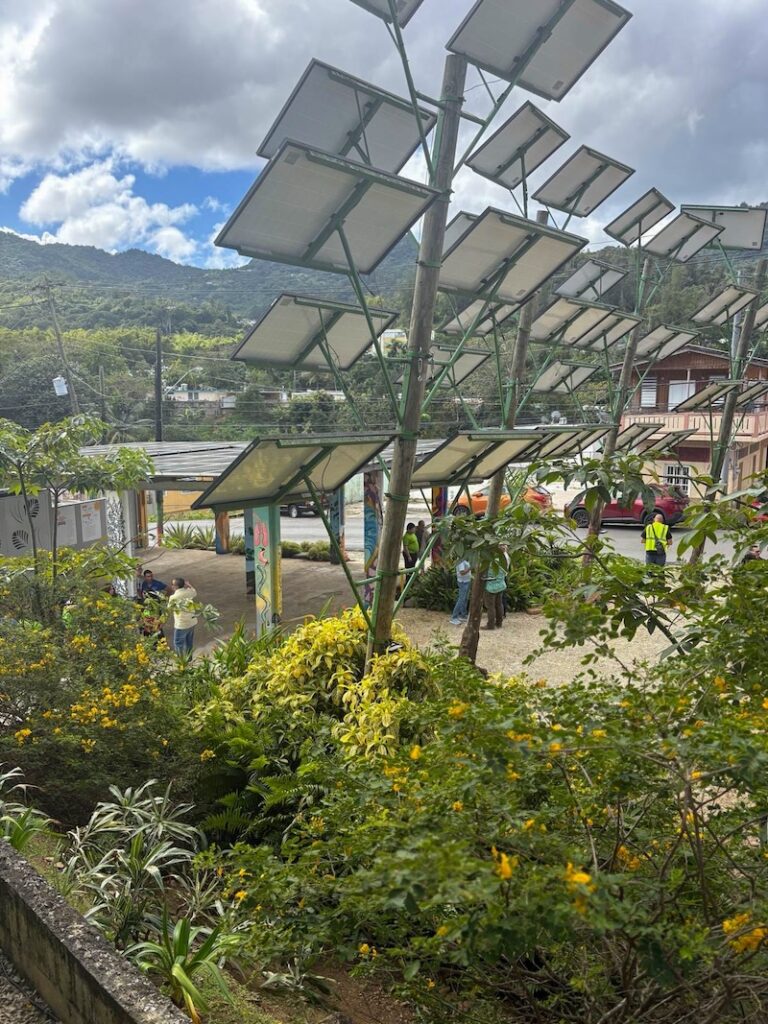
A live demonstration event showcasing the concept of solar microgrid networks as a resilient, community-based, and replicable energy model for Puerto Rico was also held on Tuesday, January 20, 2026, at Casa Pueblo in Adjuntas.
The agreement also includes a planning phase for both forests aimed at identifying priority needs such as improved access, reforestation initiatives, and enhancements to community gathering spaces such as the amphitheater and the Indigenous batey. These management actions aim to lay the groundwork for the development of new educational and ecotourism offerings beginning in 2026.
In this context, the alliance takes on special significance as Bosque del Pueblo approaches its 30th anniversary on March 21, 2026. Casa Pueblo will develop a commemorative plan with technical and conceptual support from Para la Naturaleza.
The commemoration will integrate cultural and community expressions, including workshops, arts and crafts activities, educational spaces on the importance of the Indigenous batey, and a community film festival featuring the documentary Y todavía la semilla.
The signing took place during Casa Pueblo’s presentation of its new Community Laboratory for the Energy Transition, where a live demonstration was conducted for special guests and community members on the concept of interconnected solar microgrid networks as a resilient, community-driven, and replicable energy model for Puerto Rico.
To illustrate how interconnected solar microgrids function, electrical engineer and researcher Maximiliano Ferrari, a collaborator of the Laboratory, used the “orchestrator,” an innovative technology that breaks from the current unidirectional transmission model and enables multidirectional energy exchange among communities.
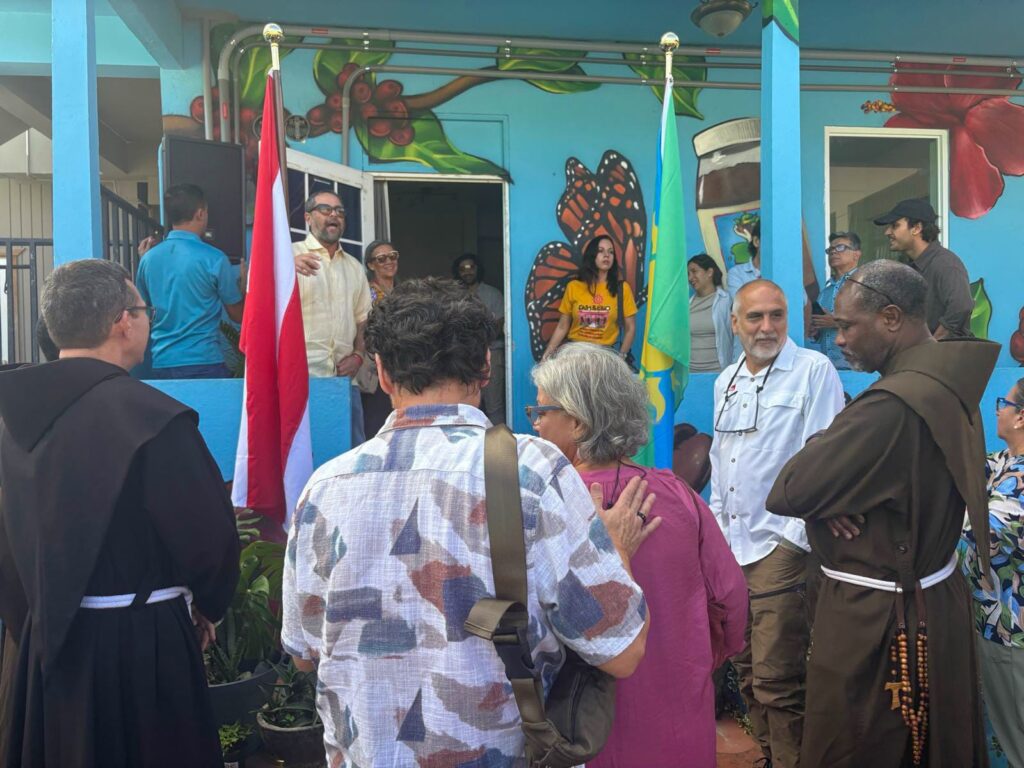
Through this system, Casa Pueblo’s microgrid and the Plaza de la Independencia Energética microgrid exchanged energy, demonstrating how they can support one another during emergencies or large-scale outages to ensure the community complex’s energy needs are met.
“The Casa Pueblo microgrid is critical, so stabilizing it is a priority. However, in the future, we aim for a broader shared benefit. We want to determine how to make the best use of available energy to support others. For example, in the event of a blackout, if we have surplus energy, we could expand and provide power to nearby households,” explained Massol Deyá.
The benefits of microgrids are numerous. They bring energy generation closer to the point of consumption, reducing the vulnerability of transmission lines and, consequently, minimizing outages. They lower electricity costs since fuel costs are zero, and they eliminate dependence on fluctuating fossil fuel prices and availability.
Additionally, microgrids are a rapidly deployable, scalable, and reproducible solution due to their modular nature. They are not expensive; what is costly and unstable is the proposed $20 billion gas procurement contract that was pushed onto the country. Because they are built from a community-based approach, they also enable reduced electricity costs through decentralization, democratization, and energy independence.
Nicky Vázquez, owner of La Conquista Laundry, has been connected to the Plaza de la Independencia Energética microgrid since mid-2025. He has experienced an 80% reduction in electricity costs and no longer suffers service interruptions.
“After Hurricane María, I continued providing service, but at a high cost because I had to use a generator. I also lost equipment due to voltage fluctuations. Now I have stability, I don’t lose power, and I can continue operating,” said Vázquez.
Meanwhile, the home of Miriam Torres Arce, a Casa Pueblo neighbor, was integrated into the microgrid last August. Since then, she and her husband, José Fernando Belvis—who has several health conditions—have experienced the peace of mind that comes from not dealing with power outages.
“Before, during hurricanes, I felt nervous and afraid because we didn’t have solar energy. Now I feel calm and at ease because I always have electricity, which is what matters most at this stage of our lives,” said Torres Arce.
The presentation of the Community Laboratory for the Energy Transition included the participation of Fernando Lloveras, president of Para la Naturaleza; Tatiana Roa, former Vice Minister of Environment of Colombia; Dr. Jorge Iván Vélez Arocho, former president of the Pontifical Catholic University of Puerto Rico; Gustavo Irizarry, president of the Adjuntas Community Solar Energy Association (ACESA); Manuel Soto of Sol de la Montaña; Caroleena Vargas of The Solutions Project; and Colibrí Sanfiorenzo and Anahí Lazarte of HASER.